

PRK Eye Surgery in NYC
PRK corrects vision with the same excimer laser as LASIK, but without cutting a corneal flap. For thin corneas, irregular topography, dry eye and contact-sport careers, it is often the safer operation — not the lesser one. Performed by Dr. Leonard Bley in Manhattan, Brooklyn and Queens.
PRK — photorefractive keratectomy — is laser vision correction performed on the surface of the cornea. Instead of creating a flap, the surgeon removes the thin epithelial layer covering the cornea, reshapes the tissue underneath with an excimer laser, and places a bandage contact lens while the epithelium grows back over the following days. The correction is the same as LASIK; the difference is how the laser is reached and how recovery unfolds. NY LASIK performs PRK for patients across Manhattan, Brooklyn and Queens.
What is PRK?
Every laser vision correction procedure does the same essential thing: it removes a precise amount of corneal tissue so that light focuses on the retina instead of in front of it. What separates the procedures is how the laser gets access to that tissue.
LASIK creates a hinged flap in the cornea, folds it back, treats the layer underneath and lays the flap down again. SMILE removes a small lens-shaped piece of tissue through a keyhole incision. PRK skips the flap entirely: the epithelium — a layer roughly 50 microns thick, about half the width of a human hair — is removed, the excimer laser reshapes the exposed surface directly, and the epithelium regenerates on its own over three to five days.
PRK is the oldest of the three, FDA approved in 1995, and it is not a dated one. Surgeons still choose it deliberately, every week, because for certain corneas it is the procedure that carries the least risk. The laser platform, the diagnostics and the treatment profiles have moved forward with everything else — what has stayed the same is the absence of a flap.
PRK compared with LASIK and SMILE
| PRK | LASIK | SMILE | |
|---|---|---|---|
| Corneal flap | None — surface treatment | Hinged flap created with a femtosecond laser | None — small keyhole incision |
| Tissue preserved | Most — no flap thickness to account for | Least — flap consumes corneal depth | Intermediate |
| Comfortable vision | Several days, sharpening over weeks | Usually the next morning | A day or two |
| Back to desk work | Around a week for most patients | One to two days | Two to three days |
| Fully stable vision | Three to six months | Weeks | Weeks |
| Long-term outcome | Comparable across all three once healing is complete | ||
| Often chosen when | Corneas are thin or irregular, dry eye is a factor, or the job carries impact risk | Corneas are healthy and thick and fast recovery matters | A flapless option is wanted with faster recovery than PRK |
The row that matters most is the second-to-last one. PRK asks more of you in the first two weeks and delivers the same destination. Choosing it is a trade of short-term convenience for long-term corneal safety — and for some eyes, it is not a trade at all, because LASIK was never on the table.
When PRK is the better operation
PRK gets described as the fallback for people who fail LASIK screening. That framing is wrong often enough to be worth correcting: there are eyes and there are lives where the absence of a flap is the entire point.
Thin corneas
A LASIK flap consumes corneal depth before the correction even begins. PRK treats the surface, so the same prescription can be corrected while leaving a thicker, structurally stronger cornea behind. This is the single most common reason PRK is recommended.
Irregular corneal surface
Anterior basement membrane dystrophy, map-dot-fingerprint changes and a history of recurrent corneal erosion all make flap creation unpredictable. Removing the epithelium and letting it regrow can improve the surface rather than disturb it.
Dry eye
Creating a flap severs corneal nerves and can worsen dryness for months. PRK disturbs far less of that nerve network, which is why it is frequently the recommendation for patients who already struggle with dry eye or contact lens intolerance.
Impact risk at work or in sport
A LASIK flap never fully re-bonds to the cornea. For boxers, martial artists, rugby and hockey players, and for military, law enforcement and fire service candidates, a procedure with no flap to displace removes a category of risk permanently.
Steep or unusually shaped eyes
Some corneal curvatures make flap creation mechanically awkward. Surface treatment sidesteps the geometry problem entirely.
Previous eye surgery
Corneal scarring or a prior procedure can rule out a clean flap. PRK is often still available where LASIK is not, though that determination is made on the scans, not on a rule of thumb.
None of this is a checklist you can apply to yourself. It is the list of findings that make Dr. Bley recommend PRK, and every one of them comes off diagnostic imaging performed at your evaluation.
How a PRK procedure works
You are in the laser suite for about fifteen minutes for both eyes. The laser itself runs for well under a minute per eye.
- Measurement. Corneal topography, pachymetry (thickness mapping), pupil measurement and a full refraction. These scans are what decide between PRK, LASIK and SMILE — the decision is made from data, not from preference.
- Numbing. Anaesthetic drops only. There are no injections and no general anaesthetic. A lid holder keeps you from blinking; you will not be able to see the instruments.
- Epithelium removed. The surface layer is lifted away from the treatment zone. This takes seconds and you feel pressure rather than pain.
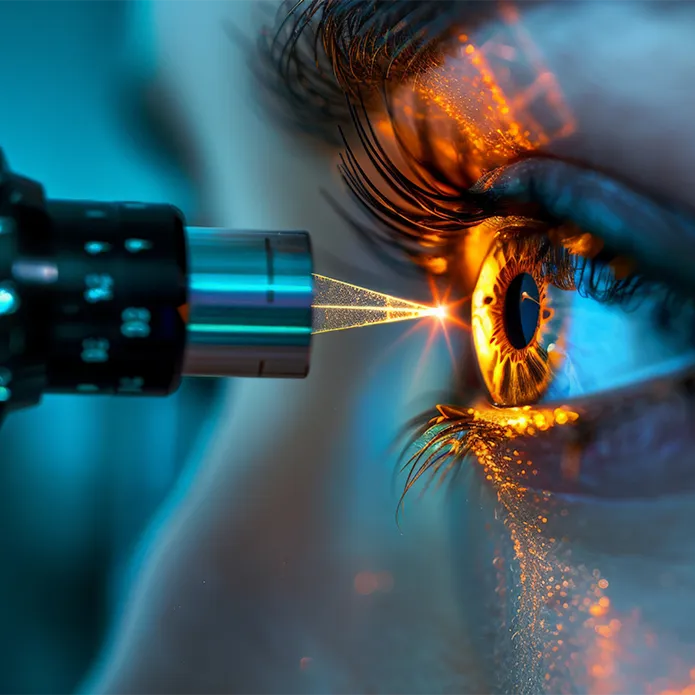
- Laser treatment. The excimer laser reshapes the cornea to your measurements while you look at a fixation light. An eye tracker follows small movements automatically.
- Bandage lens. A soft contact lens is placed on each eye to protect the surface while the epithelium regrows. It stays in for roughly four to five days.
- Home the same day. You will need someone to drive you. Drops start immediately and follow-up begins the next day.
NY LASIK performs surface treatment on the same WaveLight® EX500 excimer laser used for its LASIK procedures — the platform is shared; what changes is the approach to the cornea.
What PRK recovery actually looks like
For more detail, read our PRK recovery day-by-day guide.
PRK asks more of you than LASIK in the first two weeks. Knowing the shape of it in advance is most of what makes it manageable.
Typical ranges, not a promise. Healing speed varies with prescription, age and ocular surface health, and your own timeline is discussed at your evaluation.
- Days 1 to 3 — the hard part. Expect burning, watering, light sensitivity and the feeling of something in the eye. This is the peak, and it is genuinely uncomfortable for most people. Plan to be at home with the lights low, not at a desk. You will be given drops and oral medication to manage it.
- Days 4 to 5 — the bandage lenses come out. Once the epithelium has closed, the lenses are removed at your follow-up and the discomfort drops away quickly. Vision at this point is functional but hazy, like looking through a slightly smeared window.
- Week 1 to 2 — back to work. Most patients return to desk work within a week. Vision fluctuates through the day and is worse in the evening. Screens are tiring. Driving comes back for most people in this window, but only when your surgeon clears it.
- Weeks 3 to 8 — steady improvement. Sharpness builds week over week. Night glare and halos fade. You will still be on drops, including a steroid taper that is not optional — it is part of how haze is prevented.
- Months 3 to 6 — settled. Vision stabilises at its final quality. This is the point at which outcomes are measured, and at which any enhancement would be considered.
What we ask of you
- Take the full drop schedule. The steroid taper prevents corneal haze; stopping early is the main avoidable cause of a poor PRK result
- Wear sunglasses outdoors. UV exposure during healing contributes to haze — this matters more after PRK than after LASIK
- Do not rub your eyes, and keep water out of them — no swimming or hot tubs until you are cleared
- Keep every follow-up. Surface healing is monitored, not assumed
- Book time off honestly. Three or four days minimum; a week if your work is visual
Modern PRK protocols, including the use of mitomycin-C during treatment where the correction warrants it, have made significant corneal haze uncommon. It has not made the aftercare optional.
Are you a candidate for PRK in NYC?
You are more likely to be a candidate if:
- You are at least 18 and your prescription has been stable for about a year
- You are nearsighted or farsighted, with or without astigmatism
- Your corneas are healthy, with no keratoconus or active disease
- You can commit to the drop schedule and the follow-up visits
- You can take several days away from visually demanding work
- You are not pregnant or nursing
Thin corneas, mild surface irregularity and dry eye do not count against you here the way they do for LASIK — they are among the reasons PRK gets recommended. What rules PRK out is different: keratoconus or other corneal thinning disease, an unstable prescription, uncontrolled autoimmune or connective tissue disease that impairs healing, and, practically speaking, an inability to be diligent about drops for several weeks.
If PRK is not the answer, Dr. Bley performs the alternatives as well — which is the point of being evaluated somewhere that offers all of them.
| Procedure | How it works | Often considered when |
|---|---|---|
| PRK | The epithelium is removed and the corneal surface reshaped directly — no flap | Thin or irregular corneas, dry eye, or impact risk at work or in sport |
| LASIK | The cornea is reshaped beneath a laser-created flap | Healthy, adequately thick corneas where fast recovery is the priority |
| Contoura® Vision | Topography-guided LASIK planned from up to 88,000 corneal data points | You want the most individualised LASIK treatment available |
| ReLEx® SMILE | A lenticule is removed through a small incision — no corneal flap | You want a flapless option with a faster recovery than PRK |
| EVO ICL™ | An implantable collamer lens placed inside the eye; no corneal tissue removed | Corneas too thin even for PRK, or moderate-to-severe nearsightedness |
| Refractive Lens Exchange | The natural lens is replaced with a premium intraocular lens | Patients over 45 who also want to address reading vision and future cataract |

Why patients choose NY LASIK for PRK
The value of being evaluated here is not that we perform PRK. It is that we are not limited to it, or to anything else — so the recommendation you get is driven by your scans rather than by the equipment in the building.
Dr. Leonard M. Bley is a board-certified refractive and cataract surgeon with more than 30 years of clinical experience, Surgical Director of the Laser & Microsurgery Institute and founder of NY LASIK. He has been involved in refractive surgery since 1989 — before LASIK was formally approved by the FDA, when surface treatment was the whole of the field.
- One of only two surgeons in the City offering the full range of vision correction options
- More than 100,000 procedures performed
- In refractive surgery since 1989
- Lifetime Assurance Plan available for enhancements
- Price match guarantee on comparable technology
- Doctor of Medicine, NYU School of Medicine
What does PRK cost in NYC?
Laser vision correction in New York City generally runs between $2,000 and $4,000 per eye. PRK is typically priced in line with LASIK rather than below it — the laser time and the technology are the same, and PRK carries more post-operative visits, not fewer. Your exact price depends on your prescription, your measurements and the procedure you and Dr. Bley decide on together.
What NY LASIK does to bring it within reach:
- $1,750 off on the current offer
- 0% financing for approved applicants, so the balance is spread over monthly payments
- Tax-free HSA and FSA dollars are eligible
- Price match guarantee against a written quote from a comparable provider
Full detail on the cost of laser vision correction in NYC. The LASIK Triple Commitment sets out the practice’s guarantees — note that the written 20/20 commitment applies to Contoura patients specifically, so ask your coordinator which parts apply to your procedure.
Financing options available. Pricing may vary based on individual patient factors.
Find out which procedure your eyes need
The evaluation includes corneal mapping and thickness measurement — the two findings that decide between PRK and LASIK.
Where we perform PRK
Three offices across New York City, with the laser suite in Manhattan.

Manhattan
160 E 56th Street, #900New York, NY 10022(212) 758-3838Our Midtown East office, minutes from Lexington Avenue and the 4/5/6 and E/M lines. Serving the Upper East Side, Midtown, Murray Hill, Chelsea and the Village.

Brooklyn
1301 Avenue JBrooklyn, NY 11230(718) 627-0303In Midwood on Avenue J, convenient to Flatbush, Borough Park, Sheepshead Bay, Park Slope and Bay Ridge. Consultations and the frequent early follow-ups PRK needs, without crossing the bridge.

Queens
102-30 Queens BoulevardForest Hills, NY 11375(718) 275-7070Forest Hills, close to Rego Park, Elmhurst, Kew Gardens, Jackson Heights and Astoria, with easy access from the Long Island Expressway and the M/R lines.
PRK, answered
Is PRK as good as LASIK?
For final visual outcome, yes — studies consistently find PRK and LASIK reach comparable results once healing is complete. The difference is the road there. LASIK gives you usable vision the next morning; PRK takes one to two weeks to become comfortable and three to six months to fully settle. What PRK offers in exchange is a cornea with no flap in it, which for some eyes is worth considerably more than a fast week.
Does PRK hurt?
The procedure itself does not — anaesthetic drops mean you feel pressure, not pain. The first three days afterwards are genuinely uncomfortable: burning, watering and light sensitivity while the surface heals. You are given drops and oral medication for it, and it eases sharply once the bandage lenses come out around day four or five. We would rather you hear that plainly now than be surprised by it.
How long is PRK recovery?
The epithelium closes in three to five days. Most patients return to desk work within about a week, with vision that fluctuates and tires easily. Sharpness builds over the following weeks, and vision is fully stable somewhere between three and six months. Plan three to four days off at minimum, and a full week if your work is visually demanding.
Why would a surgeon recommend PRK over LASIK?
Most often because your corneas are too thin to give up the depth a LASIK flap requires. Other common reasons: an irregular corneal surface, basement membrane dystrophy or a history of recurrent erosion, significant dry eye, or a job or sport that carries a real risk of a blow to the eye. In those cases PRK is not a compromise — it is the procedure with the lower risk profile.
Can I have PRK if I have thin corneas?
Frequently, yes. Because no flap is created, PRK preserves more corneal tissue for the same correction, which is why it is the usual recommendation when pachymetry comes back thinner than LASIK requires. There is still a floor — corneas below a certain thickness, or with signs of keratoconus, are not candidates for any surface laser treatment. EVO ICL is often the answer for those eyes.
Is PRK better for dry eyes?
Generally yes. Creating a LASIK flap cuts across corneal nerves and can worsen dryness for months afterwards. PRK disturbs far less of that nerve supply, so patients who already have dry eye or who cannot tolerate contact lenses are often steered towards it. Your tear film is assessed as part of the evaluation.
Is PRK the right choice for athletes, military or law enforcement?
It is a common one. A LASIK flap never fully re-bonds to the cornea, so a hard blow to the eye can in principle displace it years later. Removing that possibility matters if you box, wrestle, play rugby or hockey, or work in a role where physical contact is part of the job. Some services also have their own requirements around refractive surgery — bring those to your consultation and we will work to them.
What is corneal haze, and should I worry about it?
Haze is a clouding of the healing corneal surface that can reduce clarity. It was a real limitation of early PRK. Modern treatment profiles and the use of mitomycin-C during surgery where the correction warrants it have made significant haze uncommon. The two things that keep it uncommon for you are completing the full steroid taper and wearing sunglasses outdoors during healing.
How much does PRK cost in New York City?
Laser vision correction in NYC generally runs $2,000 to $4,000 per eye, and PRK is usually priced in line with LASIK rather than under it. NY LASIK currently offers $1,750 off, 0% financing for approved applicants, HSA and FSA eligibility, and a price match guarantee. Your exact price is set at your evaluation. Financing options available; pricing may vary based on individual patient factors.
Does insurance cover PRK?
Elective vision correction is generally not covered by medical insurance. Most patients combine financing with pre-tax HSA or FSA dollars. Some vision plans offer a discount — bring your plan details to your consultation and our coordinators will check.
Can PRK be repeated if I need an enhancement?
Surface treatment can generally be repeated where enough corneal tissue remains, and enhancements are considered only once vision has fully stabilised at three to six months. The Lifetime Assurance Plan covers enhancement in defined circumstances for an additional fee paid before your procedure — ask your coordinator how it applies to PRK.
Do you perform PRK in Brooklyn and Queens?
Consultations and follow-up care are available at all three offices — Manhattan, Brooklyn and Queens — which matters more with PRK than with LASIK, because the early follow-ups are frequent. The laser suite itself is in Manhattan at 160 E 56th Street, so the procedure takes place there.
Who performs PRK at NY LASIK?
Every procedure is performed by Dr. Leonard M. Bley, MD, FACS, a board-certified refractive and cataract surgeon who has been involved in refractive surgery since 1989, with more than 100,000 procedures performed at the practice.
Find out which procedure fits your eyes
Book an evaluation in Manhattan, Brooklyn or Queens. The scans decide — and you will see them.