If you were told years ago that you were too old for EVO ICL, it may be worth asking which eligibility rule applied. The U.S. labeling has changed. For New Yorkers in their late 40s and 50s, however, the useful question is more personal: would an implantable lens address the vision problem that actually bothers you?
Can you have EVO ICL after age 45?
Potentially. The FDA expanded the indicated age range for EVO/EVO+ ICL and toric models to 21–60 in November 2025. Age alone does not establish candidacy. Prescription, internal eye measurements, corneal endothelial cells, lens clarity and overall eye health must also qualify. EVO ICL corrects nearsightedness, with eligible astigmatism correction; it does not restore the natural lens’s lost ability to focus up close.

What changed in the EVO ICL age range?
The FDA’s approval record for supplement P030016/S048 documents the expansion from ages 21–45 to ages 21–60. That is a change in device labeling, not a promise that everyone in the expanded range should have surgery. Older articles quoting a maximum age of 45 may reflect the earlier indication.
Ask for an evaluation using the current labeling for the exact lens being considered. A previous decision may still be correct if it was based on your anatomy, prescription or eye health. Bring the earlier examination report if you have it so the reason can be reviewed directly.
EVO ICL and reading glasses: separate the two goals
EVO ICL surgery places a lens inside the eye while leaving the natural lens in place. It can change the way light focuses for distance, but the natural lens continues to age. Presbyopia—the gradual loss of close-up focusing ability—can still make reading glasses necessary.
A nearsighted person may currently take off distance glasses to read. Correcting that distance prescription can change this familiar habit. Before making a decision, describe the way you read a phone, work at a monitor and see street signs. The manufacturer’s patient FAQ specifically explains that distance correction does not eliminate the possible need for reading glasses.
Bring your actual working distances to the consultation. “I edit spreadsheets on two monitors” or “I read small print at about 14 inches” gives the surgeon a better starting point than simply asking to be glasses-free. Request a clear explanation of what the proposed focus would mean for each activity.
How does EVO ICL compare with LASIK and lens replacement after 45?
| Option | What changes? | Question to discuss |
|---|---|---|
| EVO ICL | A lens is added; the natural lens remains. | Do my eyes meet the implant requirements, and what reading correction will I need? |
| LASIK or PRK | The cornea is reshaped; the natural lens remains. | Does my cornea support the intended correction, and how will presbyopia affect the result? |
| Refractive lens exchange | The natural lens is permanently replaced with an IOL. | Do the benefits justify removing the natural lens and the risks of intraocular surgery? |
| Glasses or contact lenses | Correction is worn outside the eye. | Can an updated prescription or different lens strategy meet my needs without surgery? |
See our LASIK, EVO ICL and RLE comparison for a broader overview. If your natural lens is cloudy, a cataract assessment may change the discussion. RLE is not automatically the better choice because you have reached a particular birthday.
What should an EVO ICL evaluation clarify?
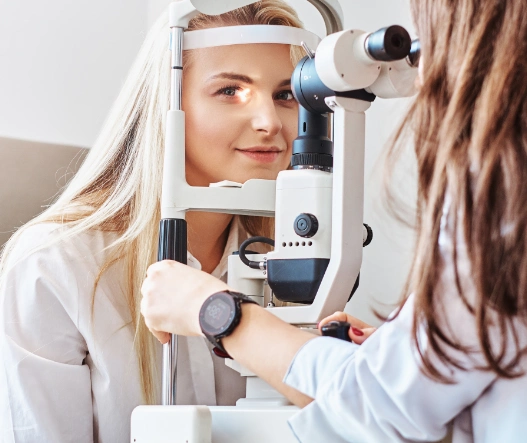
The examination should establish whether your prescription and eye anatomy meet the lens requirements. Important measurements include the space inside the front of the eye and the health of the corneal endothelial cells. Your clinician also evaluates the natural lens, eye pressure and other findings that could affect safety or benefit.
Implantation carries risks, including cataract formation, pressure problems, endothelial-cell loss, infection, retinal detachment and visual symptoms such as halos. Removal, if needed, is another operation; “removable” should not be read as a risk-free reversal. The FDA’s phakic-lens risk guide is useful preparation.
A practical consultation list for Manhattan, Brooklyn and Queens
- Bring current glasses and earlier prescriptions, especially if they have changed.
- Explain whether distance blur, reading difficulty or both are your main concern.
- Bring previous eye-surgery records and a medication list.
- List the activities for which you would accept glasses and those you most want to improve.
- Ask why the recommended procedure fits your eyes better than the alternatives.
- Confirm the testing location, follow-up arrangements and contact-lens break instructions before your appointment.
For a Manhattan office worker, Brooklyn caregiver or Queens commuter, the right discussion connects the examination with a real routine. An online age checklist cannot make that decision.
Frequently asked questions
Is 45 still the upper age limit for EVO ICL?
No. Current U.S. labeling includes eligible adults through age 60. A complete examination must establish whether the other requirements are met.
Will EVO ICL get rid of reading glasses?
It is intended to correct distance refractive error. It does not reverse presbyopia, and reading glasses may still be needed.
Does EVO ICL treat farsightedness in the United States?
The U.S. EVO indication discussed here is for nearsightedness, with or without eligible astigmatism. Farsighted patients need a different treatment discussion.
Should I automatically choose RLE if I am over 50?
No. Lens clarity, retinal health, remaining near focus and the alternatives matter. Age alone should not decide whether your natural lens is removed.
Discuss what vision correction could change for you
Bring your distance and reading priorities to an evaluation with NY LASIK. Your examination can clarify whether EVO ICL, a corneal procedure, lens replacement or continued optical correction fits your eyes.

About Dr. Leonard Bley
Leonard Bley, MD, FACS is the founder and surgical director of NY LASIK’s Laser & Microsurgery Institute. His practice provides refractive and cataract care in New York City.
Sources and further reading
General patient education. Your examination and treating clinician’s instructions determine the appropriate treatment and recovery plan.