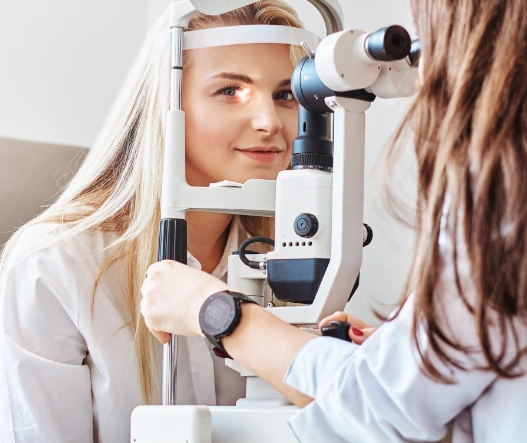
If thick glasses or contact-lens difficulties have you considering RLE for high myopia in NYC, the strength of your prescription is only the beginning. Refractive lens exchange can change the eye’s focusing power, but it permanently removes the natural lens. For a highly nearsighted eye, retinal health deserves particular attention before an elective operation.
Is refractive lens exchange a good choice for high myopia?
Sometimes, but high myopia alone is not a reason to choose RLE. The decision depends on the natural lens, age-related near-vision changes, eye length, retinal findings and alternatives. Highly nearsighted eyes already face increased retinal-detachment risk, and lens removal adds considerations that deserve an individual discussion. Glasses, contact lenses, corneal laser procedures or a phakic lens may be preferable for some patients.

RLE replaces the natural lens; EVO ICL leaves it in place
In refractive lens exchange, the natural lens is removed and replaced with an intraocular lens. The operation uses the same basic lens-removal approach as cataract surgery, but the purpose differs when a visually significant cataract is not present. Removing a clear lens is an elective decision with lasting consequences.
A phakic intraocular lens, such as EVO ICL, is placed inside the eye while the natural lens remains. The FDA’s EVO ICL information explains the distinction and the importance of eligibility requirements. Your prescription is not enough to establish candidacy: age, internal eye dimensions, endothelial-cell health and other findings matter.
Ask the surgeon to say explicitly whether the proposed procedure removes or preserves your natural lens. “Lens surgery” can mean different things, and that difference should be clear before you compare prices or recovery plans.
Why high myopia changes the lens-replacement discussion
High myopia often involves a longer eye. Correcting the focusing error does not shorten the eye or erase existing retinal changes. A strong prescription and a healthy-looking front of the eye do not tell the whole story.
The Royal College of Ophthalmologists’ RLE patient guide identifies retinal detachment as an important risk of lens replacement, particularly for very nearsighted people. A general complication percentage from a website cannot replace an assessment of your own risk.
Discuss your eye length, retinal examination, any previous tears or detachment, eye injuries and relevant family history. Ask whether a retinal specialist should assess your eyes before a decision. Additional evaluation may clarify risk, but it should not be described as making surgery risk-free.
Removing the lens also changes natural focusing
The natural lens’s remaining ability to change focus is lost when it is removed. That tradeoff can be especially important if you can still read comfortably by taking off your distance glasses. An implant and its focusing target may provide a useful range, but they do not simply recreate a younger natural lens.
Try this consultation question: “If we target distance vision, what happens to the close-up vision I currently get without glasses?” Ask about books, a phone and your actual work distances rather than accepting a general promise of reduced glasses dependence.
Compare the options that fit your examination
| Option | Natural lens | Discussion point |
|---|---|---|
| Glasses or contact lenses | Preserved | Can a different prescription or fitting address the main difficulty without surgery? |
| LASIK or PRK | Preserved | Does the cornea safely support the amount and type of correction required? |
| Phakic lens, including EVO ICL | Preserved | Do age, prescription, internal dimensions and other findings meet the device requirements? |
| Refractive lens exchange | Removed and replaced | Do the expected benefits justify lens removal and the individual retinal and surgical risks? |
| Cataract surgery | Cloudy lens removed and replaced | Is a cataract contributing enough to the visual problem to change the treatment discussion? |
This is a list of questions, not a ranking. Being outside the range for one procedure does not automatically make another appropriate. The FDA’s LASIK candidacy guidance discusses factors such as corneal thickness, prescription stability and eye health.
If your main issue is a high prescription with a clear lens, discuss lens-preserving choices. If the lens has become cloudy, ask how much of your difficulty is due to the cataract. If reading vision is changing with age, describe what you want to improve and which compromises you would accept.
Measurements and expectations matter as much as the procedure name
Long eyes require careful implant-power planning. A remaining prescription is possible after lens replacement, and glasses or further treatment may still be needed. The AAO EyeWiki discussion of high myopia and cataract surgery describes measurement and retinal considerations in highly myopic eyes.
Request an explanation of the intended focus for each eye and the plan if the outcome differs from the target. Ask which additional treatments would be clinically appropriate and how they would be charged. A lens exchange is another operation, not a simple undo button.
A practical high-myopia consultation checklist for NYC
- Bring your current prescription and any records showing how it has changed.
- Bring details of previous LASIK, retinal laser treatment, injections, injury or other eye surgery.
- Describe your contact-lens problems and what you have already tried.
- List your preferred reading, screen and distance activities—including night driving.
- Ask why the recommended procedure fits better than the alternatives you qualify for.
- Request an itemized quote, follow-up plan and explanation of additional-treatment costs.
Our RLE cost guide and EVO ICL cost guide can help organize the financial questions. In Manhattan, Brooklyn or Queens, confirm the location of each appointment and leave time for dilation, transportation and follow-up care.
Retinal symptoms require prompt attention
New flashes, a sudden shower of floaters, a dark curtain or a sudden loss of vision warrant immediate eye care, whether or not you have had surgery. The National Eye Institute identifies retinal detachment as an emergency. Do not wait for a scheduled refractive consultation to report these symptoms.
Frequently asked questions
Does a very strong prescription automatically make me an RLE candidate?
No. Your prescription must be considered alongside the natural lens, eye length, retina, focusing needs and alternatives. An examination is required.
Does RLE cure the retinal risks of high myopia?
No. Correcting focus does not remove the structural retinal risks associated with a highly myopic eye. Ongoing eye care remains important.
Is EVO ICL the same as refractive lens exchange?
No. EVO ICL is a phakic lens placed without removing the natural lens. RLE removes and replaces that lens. Each procedure has its own eligibility requirements and risks.
Could I still need glasses after RLE?
Yes. Lens design, intended focus, residual prescription and eye health affect the result. Discuss specific tasks that may still require glasses.
Can a cataract change the recommendation?
Yes. If a cataract contributes to your vision problem, the benefits and timing of lens removal may differ from elective removal of a clear lens. Your surgeon should explain that distinction.
What should I ask Dr. Bley about high myopia?
Ask how your retinal findings and eye length affect risk, what happens to your current reading vision, which alternatives fit your eyes, and how follow-up or residual prescription would be managed.
Explore the options that fit your eyes
Schedule a vision-correction consultation with NY LASIK in Manhattan, Brooklyn or Queens. Bring your records and questions so the discussion can address your prescription, retinal health and day-to-day goals together.
Manhattan · Brooklyn · Queens · 888-NY-LASIK

About Dr. Leonard Bley
Leonard Bley, MD, FACS is the founder and surgical director of NY LASIK’s Laser & Microsurgery Institute. His practice provides refractive and cataract care in New York City.
Sources and further reading
- Royal College of Ophthalmologists: RLE patient guide
- NEI: Retinal detachment
- FDA: EVO ICL information
- FDA: LASIK candidacy
- AAO EyeWiki: High myopia and cataract surgery
This article provides general education. Your eye examination and your treating clinician’s advice determine the options appropriate for you. The editorial image depicts a fictional person.